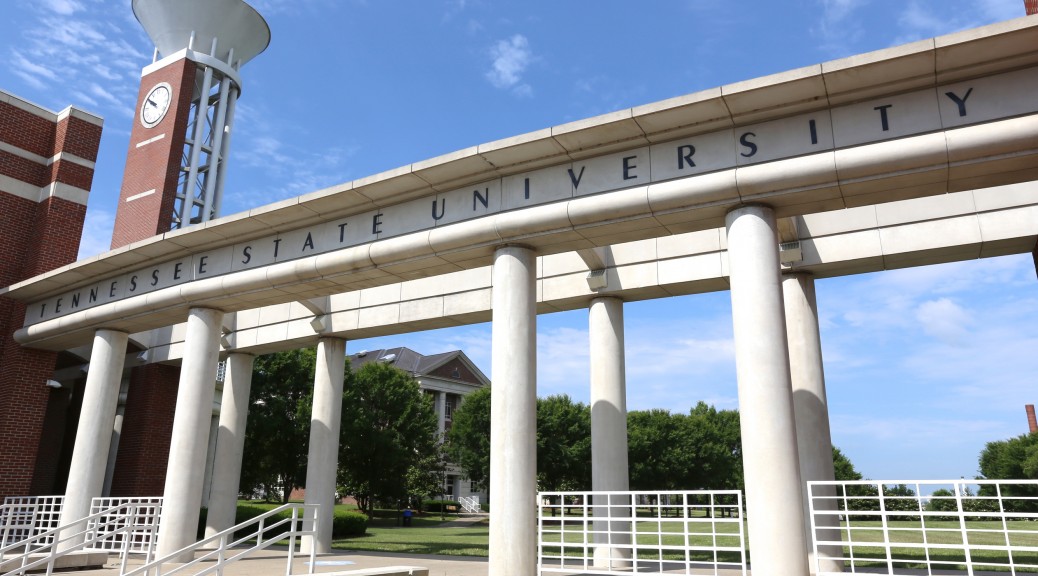
NASHVILLE, Tenn. (TSU News Service) – Tennessee State University is 103 years old today. President Glenda Glover joins the University family of alumni, faculty, staff, students and friends in wishing this great institution a HAPPY BIRTHDAY.
Founded in 1912 as the Agricultural and Industrial Normal School for Negroes, Tennessee State University (TSU) today is a comprehensive, urban, coeducational, land-grant institution serving students from all across the globe. From 247 students who began their academic career on June 19, 1912, the University has more than 9,000 students on two locations—the 500-acre main campus and the downtown Avon Williams campus.
The University is recognized as a Carnegie Doctoral/Research institution and offers 45 bachelor’s degrees, 24 master’s degrees and seven doctoral degrees in the areas of biological sciences, computer information systems engineering, psychology, public administration, curriculum and instruction, administration and supervision, and physical therapy. The University also boasts an outstanding athletics and sports legacy with 40 Olympic medals.
TSU has produced outstanding graduates who are impacting the world in science, research, the arts, theater and many other areas. This legacy of achievement and excellence has remained a hallmark of the institution and will continue years to come.
Tennessee State University
3500 John Merritt Boulevard
Nashville, Tennessee 37209
615.963.5331
About Tennessee State University
With more than 9,000 students, Tennessee State University is Nashville’s only public university, and is a comprehensive, urban, co-educational, land-grant university offering 45 undergraduate, 24 graduate and seven doctoral programs. TSU has earned a top 20 ranking for Historically Black Colleges and Universities according to U.S. News and World Report, and rated as one of the top universities in the country by Washington Monthly for social mobility, research and community service. Founded in 1912, Tennessee State University celebrated 100 years in Nashville during 2012. Visit the University online at tnstate.edu.
NASHVILLE, Tenn. (TSU News Service) – Social equity is the promotion of fair, just and equitable distribution of public services, but how can technology and data be used to drive policy and effective programmatic solutions to enhance social equity? That was the question more than 150 experts, including academics, government employees and non-profit practitioners from across the nation, grappled with when they met at Tennessee State University for a three-day conference June 3-5.
“Leveraging Technology and Data to Promote Social Equity,” was the focus of the 14th Annual Social Equity Leadership Conference (SELC), which offered participants the opportunity to deliberate and analyze the changing world of technology and data and its impact on public policy in the area of equitable social change. Specifically, participants discussed new trends in the technological application of data collection, analysis, policy implementation, service delivery and community change. The goal was to increase research and its effective application for the use of technology and data to drive policy and programmatic solutions.
Nashville Mayor Karl Dean makes remarks at the 14th Annual Social Equity Leadership Conference at Tennessee State University. (Submitted Photo)
The conference was hosted by the College of Public Service and Urban Affairs, in partnership with the TSU Center on Aging Research and Education Services. It brought together experts and participants from a diverse group of institutions, including the University of California at Los Angeles, Rutgers, University of Massachusetts-Boston, University of North Carolina, University of Louisville, Vanderbilt University, Lipscomb University and the University of Mississippi. Participants also came from federal and state agencies including the Federal Reserve, the Veterans Administration, the General Accounting Office, the Tennessee Department of Human Resources, and the Mayor’s office.
The SELC, established by the National Academy of Public Administration, aims to advance knowledge and understanding of applied and theoretical research in social equity in governance.
Participants listen to a presenter during a break-out session at the 14th Annual Social Equity Leadership Conference. (Photo by Emmanuel Freeman, TSU Media Relations)
“We are proud and honored that we were selected to host this national conference,” said Dr. Michael Harris, dean of the College of Public Affairs and Urban Studies. “It reflects national recognition among our peers of the academic quality and relevance of CPSUA. The conference allowed the college and TSU the opportunity to facilitate and participate with national experts in timely and relevant discussions as they relate to public policy, specifically social equity and leadership.”
Keynote speakers were Nashville Mayor Karl Dean; Chair of the NAPA Standing Committee on Social Equity, Dr. Blue Woodridge; and the Commissioner of the Tennessee Department of Human Resources Rebecca Hunter.
Sponsors included Nelson & Sue Andrews Institute for Civic Leadership, The Frist Foundation, the National Association of Schools of Public Affairs and Administration, the Tennessee Human Rights Commission, Safe Haven Family Shelter, and the American Society for Public Administration.
Tennessee State University
3500 John Merritt Boulevard
Nashville, Tennessee 37209
615.963.5331
About Tennessee State University
With more than 9,000 students, Tennessee State University is Nashville’s only public university, and is a comprehensive, urban, co-educational, land-grant university offering 45 undergraduate, 24 graduate and seven doctoral programs. TSU has earned a top 20 ranking for Historically Black Colleges and Universities according to U.S. News and World Report, and rated as one of the top universities in the country by Washington Monthly for social mobility, research and community service. Founded in 1912, Tennessee State University celebrated 100 years in Nashville during 2012. Visit the University online at tnstate.edu.
NASHVILLE, Tenn. (TSU News Service) – Spending your summer vacation touring ruins of monuments of Greek gods and goddesses in the ancient city of Ephesus, part of the eastern Roman Empire, can be quite an experience. For senior Music major Requel Stegall, it was “beyond life changing.”
“I had one of the best educational experiences of my college career, said Stegall,” one of 18 students from TSU and three other TBR institutions, who visited Turkey on a three-week study-abroad program this summer. “Learning about a culture I was unfamiliar with really broadened my outlook on life and allowed me to discover myself even more.”
Brianne Rucker, right (front), a TSU senior Music major, shares an earphone with a Turkish student during one of the students’ daily bus rides to or from class. (Submitted Photo)
Stegall and her fellow students, representing majors in Computer Science, Music, Human Performance and Sports Sciences (HPSS), History, and English, visited five cities and collaborated with students from three Turkish universities. The study-abroad program is organized through the Tennessee Consortium for International Study, and is the third to Turkey.
According to Dr. Robert Elliott, one of two TSU faculty members on the trip, this year’s visit engaged the students in academics, excursions and cultural exchanges with their Turkish counterparts. He and his TSU colleague, Dr. Ali Sekmen, professor and chair of Computer Science, taught combined classes with TSU and Turkish students as part of the academic experience.
“Teaching music, literature, and humanities in-country provided authentic learning experiences for students as they examined cultural differences and similarities,” said Elliott, professor and chair of the Department of Music. “Along the way, students interacted with Turkish peers and learned that people of the world are not as different from one another as they had initially thought.”
Two TSU students, Darrell Butler, left, an Architectural Engineering major; and Tim Darrah, majoring in Computer Science, study in their hotel room in Ankara, as they prepare for classwork the next day. (Submitted Photo)
Like Stegall, Sarah Needleman, an HPSS major, said the classroom settings and pairing with “our Turkish buddies” helped them to better understand the culture and traditions of the people and places they visited. “This study-abroad to Turkey was the best thing I have been a part of at TSU,” Needleman said. “I left Turkey not only with new subject knowledge in the music class I took, but also with lifelong friends – some in Nashville and some across the globe.”
2015 study-abroad participants and their professors from TSU and three other TBR institutions join their Turkish peers for one last group celebration before heading back to the United States. (Submitted Photo)
Other TBR institutions with students in this year’s TnCIS study-abroad program to Turkey were Pellissippi State Community College, Southwest Tennessee Community College, Motlow State Community College and Jackson State Community College.
According to Sekmen, Turkish institutions that participated this year were Yasar University, Atilim University and Yildiz Technical University. Other cities visited include Istanbul, Ankara and Izmir.
“It was delightful to see how our students and their Turkish peers could develop life-long friendships in such a short visit,” Sekmen said. “With a right blend of academics, excursions and cultural exchange, the program provided a unique life-time experience for students from TSU and the other TBR institutions.”
Tennessee State University
3500 John Merritt Boulevard
Nashville, Tennessee 37209
615.963.5331
About Tennessee State University
With more than 9,000 students, Tennessee State University is Nashville’s only public university, and is a comprehensive, urban, co-educational, land-grant university offering 45 undergraduate, 24 graduate and seven doctoral programs. TSU has earned a top 20 ranking for Historically Black Colleges and Universities according to U.S. News and World Report, and rated as one of the top universities in the country by Washington Monthly for social mobility, research and community service. Founded in 1912, Tennessee State University celebrated 100 years in Nashville during 2012. Visit the University online at tnstate.edu.
Tennessee State University’s College of Business is bridging curriculum with practical training for students by engaging business and industry professionals into the life of the college.
Through six advisory boards focused on specific aspects of their diverse degree programs, the college is preparing the next generation of business leaders for the workforce by making those connections while they are learning.
Retired Army Maj. Gen. Frank L. Miller, a retired senior Dell executive and former chair of the Supply Chain Management Governing Board, is credited with the vision behind the establishment of the College of Business’ Leadership Case Challenge Competition.
Among those alignments include Accounting, Alumni, Business Information Systems, Economics and Finance, and Supply Chain Management advisory and governing boards. The College of Business Advisory Board, designated for the entire college, has been active for more than 30 years and influential in bringing corporate support to the college. The Board has most recently sponsored a faculty retreat, offered scholarships, supported faculty research, and assisted the College in planning and orchestrating the Frank L. Miller, Jr. MBA Case Competition designed to provide MBA candidates with a forum to build and exercise their leadership skills.
Each board has specific goals but generally all work toward helping students find success while in the classroom and when they complete college.
“The jobs driving today’s economy require not only content knowledge in a given field, but those who can work well with others, communicate effectively and help companies solve some of the challenges they face,” said TSU President, Dr. Glenda Glover. “The expertise our advisory board members bring to the table are invaluable as our students learn to leverage and strengthen their skills for success in a competitive job market.”
Additionally, the boards, which are made up of professionals representing a cross-section of business and industry, focus on introducing students to potential employers, offer mentoring support, raise funds for scholarships, provide internship opportunities, sponsor students to attend conferences, and professional and leadership development sessions, and foster a sense of giving back.
Dr. Millicent Lownes-Jackson
“The College of Business has been deliberate in exposing students to real-world interactions as part of their academic experience. With the rapid advances that technology and other industry standards create in the global business environment, it is increasingly important that today’s business leaders are versatile and equipped in handling a number of trending issues,” said Dr. Millicent Lownes-Jackson, dean of the College of Business. “The mentoring, training, internships, scholarships, and career opportunities that our advisory boards provide not only help students with their academic preparation, but prepare them to be critical thinkers and problem solvers once they enter the workforce.”
Tennessee State University
3500 John Merritt Boulevard
Nashville, Tennessee 37209
615.963.5331
About Tennessee State University
With more than 9,000 students, Tennessee State University is Nashville’s only public university, and is a comprehensive, urban, co-educational, land-grant university offering 45 undergraduate, 24 graduate and seven doctoral programs. TSU has earned a top 20 ranking for Historically Black Colleges and Universities according to U.S. News and World Report, and rated as one of the top universities in the country by Washington Monthly for social mobility, research and community service. Founded in 1912, Tennessee State University celebrated 100 years in Nashville during 2012. Visit the University online at tnstate.edu.
NASHVILLE, Tenn. (Tennessee State University Sports Information)– The Tennessee State University Athletic Department received news Thursday that due to a recalculation of the football program’s multi-year Academic Progress Rate (APR), the team is not subject to a postseason ban or Level I penalty for the upcoming season.
“We appreciate the NCAA’s recalculations and are extremely happy for our players, coaches, and the entire University family,” said Tennessee State University President Glenda Glover. “The football program is an integral part of campus life as we educate well rounded young men and women at TSU.”
“Although many perceive the APR as purely academic, it is actually more complex than that with retention being an equal part of the calculation,” director of Athletics Teresa Phillips said. “The athletics department, university and football staff will continue to work together in meeting and exceeding the standards established by the NCAA.”
On May 27, the NCAA published its annual report in which the Tennessee State University football program’s rate was deemed to be below the benchmark set by the NCAA. Today’s news confirms TSU is in compliance with the NCAA’s academic standards.
Tennessee State University
3500 John Merritt Boulevard
Nashville, Tennessee 37209
615.963.5331
About Tennessee State University
With more than 9,000 students, Tennessee State University is Nashville’s only public university, and is a comprehensive, urban, co-educational, land-grant university offering 45 undergraduate, 24 graduate and seven doctoral programs. TSU has earned a top 20 ranking for Historically Black Colleges and Universities according to U.S. News and World Report, and rated as one of the top universities in the country by Washington Monthly for social mobility, research and community service. Founded in 1912, Tennessee State University celebrated 100 years in Nashville during 2012. Visit the University online at tnstate.edu.
NASHVILLE, Tenn. (TSU News Service) – Tennessee State University is one of the top Historically Black Colleges and Universities in the nation, according to College Choice, an independent online publication that helps students and their parents find the right college. In its 2015 ranking of the Best Historically Black Colleges and Universities, the publication listed TSU number 16 of the top 25 in the nation.
TSU was noted for fostering “a rich educational atmosphere by ensuring collaborative learning, meaningful student-faculty interaction, and opportunities for community engagement.” According to the publication, TSU also graduates the highest number of African-American bachelor’s degree holders in agriculture, agriculture operations, and agriculture-related sciences.
“The College Choice ranking for our programs and offerings reflect the success Tennessee State University has achieved in providing students with the experiences and education they need to make a difference in our world,” President Glenda Glover said. “We are especially gratified that leaders in higher education across the country gave us top marks for our academic programs and the learning environment we provide to students.”
The College Choice ranking, which considers factors such as academic reputation, financial aid offerings, overall cost, and success of graduates in the post-college job market, is just one of many national recognitions TSU has received this year. The University has also been recognized as the top provider of online programs in Tennessee.
Additionally, Best Value Schools, which focuses on gauging college
affordability, ranked TSU number 34 of the 100 most affordable universities in the nation. “From Aeronautical and Industry Technology to Urban Planning, from Architectural Engineering to Speech Communication, TSU simply offers too many course options for you to ever be bored,” the publication noted.
“While the United States grapples with the problem of providing college students a quality education at an affordable price, we are able to offer students attending Tennessee State University a wide variety of academic programs that employers demand,” said Dr. Mark Hardy, vice president for Academic Affairs. “We are doing this while keeping the expense of those programs at an economical level.”
Last year, The College Database, a free, non-commercial website that provides future and post-secondary students and their families with “accurate and valuable” college and career-related information, also said that TSU graduates enter the workforce earning an average $42,000 per year. The report gave TSU a top ranking among colleges and universities in Tennessee with tuition rates below $20,000, adding that the University offers the best return on financial investment when compared to other post-secondary institutions in the state.
In another listing this year, Affordable College Online, which focuses
on distance learning nationwide, ranked TSU number one in Tennessee among colleges and universities with online programs. It highlighted the University’s 18 fully online programs for undergraduate and graduate studies focused on professional studies with concentrations in leadership, nursing, teaching and more. While naming TSU as the university with the lowest tuition among its peer institutions in the state, the publication also pointed to a number of professional licensure programs offered by the institution.
“Tennessee State University prides itself on offering affordable and quality on-ground and online degree programs,” said Dr. Evelyn E. Nettles, associate vice president for Academic Affairs, whose office handles distance and online education. “Students are guaranteed exposure to a highly qualified faculty, a wide-range of student and academic support services, and reliable technology infrastructure, at a reasonable overall cost.”
Tennessee State University
3500 John Merritt Boulevard
Nashville, Tennessee 37209
615.963.5331
About Tennessee State University
With more than 9,000 students, Tennessee State University is Nashville’s only public university, and is a comprehensive, urban, co-educational, land-grant university offering 45 undergraduate, 24 graduate and seven doctoral programs. TSU has earned a top 20 ranking for Historically Black Colleges and Universities according to U.S. News and World Report, and rated as one of the top universities in the country by Washington Monthly for social mobility, research and community service. Founded in 1912, Tennessee State University celebrated 100 years in Nashville during 2012. Visit the University online at tnstate.edu.
NASHVILLE, Tenn. (TSU News Service) – Congratulations to 2,117 students who made the Dean’s List at Tennessee State University for the Spring 2015 semester. The honor list names all students who have achieved a grade point average of 3.0 or higher in 12 or more semester hours taken for a letter grade during the spring semester.
Students on the coveted list for Spring 2015 are listed alphabetically. Students who have opted out of publicly sharing their private information are not listed. Again, congratulations! Here are the honorees:
NASHVILLE, Tenn. (TSU News Service) – Dr. Maria Thompson, a Tennessee State University graduate, and former vice president for Research and Sponsored Programs, is the new president of Coppin State University, a part of the University System of Maryland.
Dr. Maria Thompson
USM Chairman James Shea announced Thompson’s appointment recently, describing her as a “top-level academic leader.”
“Dr. Thompson’s earlier experience in building a research enterprise at an urban historically black institution positions her well to advance Coppin as a vital institution in Baltimore and the state,” Shea said.
TSU President Glenda Glover said the TSU family is “extremely” proud to see one of its products excel to such a high profile position in the academic world.
“We congratulate Dr. Thompson on becoming president of Coppin State University, a sister HBCU institution,” President Glover said. “We are very proud of her outstanding achievements and demonstration of excellence. The faculty, students and staff of Coppin State are very fortunate to have one of our finest to lead that great institution.”
Thompson, whose appointment takes effect July 1, is the provost and vice president of Academic Affairs at the State University of New York at Oneonta. From August 2009-July 2011, she served as vice president for Research and Sponsored Programs at TSU. Prior to that, she served in many other research capacities at TSU.
At SUNY, Thompson was credited with oversight of accreditation reaffirmation, and academic development for more than 6,000 students. At Tennessee State, she helped to secure more than $45 million in sponsored research funding from external resources.
“I look forward to working with the faculty, staff, students and other stakeholders of Coppin State to continue the university’s commitment to preparing graduates who are analytical, socially responsible and lifelong learners,” Thompson said. “Urban higher education plays a vital role in shaping the future of local, national and global communities and I am excited about joining a campus with a rich legacy of community engagement.”
Thompson is a 1983 graduate of TSU with a Bachelor of Science degree. She holds an M.S. from The Ohio State University, and a Ph.D. from the University of Tennessee at Knoxville.
Tennessee State University
3500 John Merritt Boulevard
Nashville, Tennessee 37209
615.963.5331
About Tennessee State University
With more than 9,000 students, Tennessee State University is Nashville’s only public university, and is a comprehensive, urban, co-educational, land-grant university offering 45 undergraduate, 24 graduate and seven doctoral programs. TSU has earned a top 20 ranking for Historically Black Colleges and Universities according to U.S. News and World Report, and rated as one of the top universities in the country by Washington Monthly for social mobility, research and community service. Founded in 1912, Tennessee State University celebrated 100 years in Nashville during 2012. Visit the University online at tnstate.edu.
NASHVILLE, Tenn. (TSU News Service) – Dr. Harriette Bias- Insignares, a longtime professor at Tennessee State University and the first African American Poet Laureate/Ambassador of Letters for the State of Tennessee has died. She was 72 years old.
A graduate of Fisk University, the University of Wisconsin-Whitewater, and George Peabody College of Vanderbilt University, Bias-Insignares had been an educator for more than 40 years. She taught English as a second language, rhetoric and public address, theatre and journalism.
Bias-Insignares began her career teaching English and physical education in Bucaramanga, Colombia, from 1964-65. She later became the Spanish resource consultant for the Chicago Board of Education from 1966 until 1968, and the director of the Tutorial Center at the University of Wisconsin from 1970-72. From 1977 until 1980, Bias-Insignares was an assistant professor of Speech at the University of Tennessee in Nashville.
Dr. Harriette Bias- Insignares from the 1993 TSU yearbook, Tennessean. Bias-Insignares joined the faculty at Tennessee State University as an associate professor of Communications, a position she held from 1981 until 2000.
Dr. Bias-Insignares joined the faculty at Tennessee State University as an associate professor of Communications, a position she held from 1981 until 2000. While at the University, she received the TSU Outstanding Teacher Award, the TSU Foundation Scholars Award, and the TSU National Broadcasting Society Journalism Teacher of the Year Award. Her other awards included the Consortium of Doctors Trailblazer Award, and the Society of Professional Journalists’ David L. Eshelman Award.
Bias-Insignares started writing poetry in earnest following the assassinations of John F. Kennedy, Dr. Martin Luther King Jr., and Bobby Kennedy. Since 1977, she served the state of Tennessee as its Official State Poet and Arts Advocate under the title “Tennessee’s Ambassador of Letters.” To honor her for her many years of service to the people of Tennessee through poetry, Bias-Insignares was named the first Poet Laureate of Nashville.
A native of Savannah, Georgia, Bias-Ingnares was widely recognized as a poetess, storyteller, and oral interpreter. In her role as Tennessee’s state poet she wrote poetry honoring men and women like Vice President Al Gore, Colin Powell, and Eartha Kitt, as well as groups such as The National Urban League and the Negro Ensemble Company.
Her awards in Poetry included the Society of Poets International Poet of Merit Medallion, the Phyllis Wheatley Poetry Award, the Alpha Kappa Alpha Award for contributions to American literature, and the Tennessee Governor’s Spotlight Award for Contributions to the Arts. In addition, Bias-Insignares was also recognized for the Desert Storm Poetry Memorial she created, the first poetry memorial honoring the military in the nation. For her efforts she received the Adjutant General’s Distinguished Patriot Medallion, for “singular sacrifice and commitment to sustaining the pride and patriotism of our armed forces.”
Tennessee State University
3500 John Merritt Boulevard
Nashville, Tennessee 37209
615.963.5331
About Tennessee State University
With more than 9,000 students, Tennessee State University is Nashville’s only public university, and is a comprehensive, urban, co-educational, land-grant university offering 45 undergraduate, 24 graduate and seven doctoral programs. TSU has earned a top 20 ranking for Historically Black Colleges and Universities according to U.S. News and World Report, and rated as one of the top universities in the country by Washington Monthly for social mobility, research and community service. Founded in 1912, Tennessee State University celebrated 100 years in Nashville during 2012. Visit the University online at tnstate.edu.
NASHVILLE, Tenn. (TSU News Service) – A team of astronomers using ground-based telescopes in Arizona, California, and Hawaii recently discovered a planetary system orbiting a nearby star that is only 54 light-years away from our solar system. All three of its planets orbit their star at a distance closer than Mercury orbits the Sun, completing their orbits in just 5, 15, and 24 days.
The astronomers, from Tennessee State University, the University of Hawaii at Manoa, the University of California, Berkeley, and the University of California Observatory found the planets using measurements from the Automated Planet Finder (APF) Telescope at Lick Observatory in California, the W. M. Keck Observatory on Mauna Kea, Hawaii, and the TSU APFs at Fairborn Observatory in the Patagonia Mountains of southern Arizona.
The TSU moonlight telescopes at the Fairborn Observatory in the Patagonia Mountains of Southern Arizona helped researchers discover a planetary system orbiting a nearby star that is only 54 light-years away from our solar system. (courtesy photo)
The team discovered the new planets by detecting the wobble of the star HD 7924 as the planets orbited and pulled on the star gravitationally. The APF and Keck Observatory traced out the planets’ orbits over many years using the Doppler technique that has successfully found hundreds of mostly larger planets orbiting nearby stars. In coordination with the APF and Keck Observations, the TSU APF made crucial brightness measurements of HD 7924 over nine years to assure the validity of the planet discoveries.
TSU has also been developing and operating robotic telescopes for over 20 years.
“The robotic telescopes are a wonderful advancement,” said TSU astronomer, Dr. Gregory Henry, who oversees the operation of seven robotic telescopes for his research. “They take away the tedium of all-night, manual observing sessions and produce far more superior data.”
One of the TSU robotic telescopes discovered the first transiting extrasolar planet in 1999, providing final proof of the existence of other planetary systems.
The Keck Observatory found the first evidence of planets orbiting HD 7924, discovering the innermost planet in 2009 using the HIRES instrument installed on the 10-meter Keck I telescope. This same combination was also used to find other super-Earths orbiting nearby stars in planet searches led by UH astronomer Andrew Howard and UC Berkeley Professor Geoffrey Marcy. It took five years of additional observations at Keck, a year-and-a-half campaign by the APF Telescope, and nine years of APT monitoring to find the two additional planets orbiting HD 7924.
According to Henry, the Kepler Space Telescope has discovered thousands of extrasolar planets and demonstrated that they are common in our Milky Way galaxy. However, nearly all of these planets are far from our solar system, he said.
“Most nearby stars have not been thoroughly searched for the small ‘super-Earth’ planets (larger than Earth but smaller than Neptune) that Kepler found in great abundance,” Henry added.
This discovery shows the type of planetary system that astronomers expect to find around many nearby stars in the coming years.
“The three planets are unlike anything in our solar system, with masses 7-8 times the mass of Earth and orbits that take them very close to their host star,” said UC Berkeley graduate student Lauren Weiss.
Henry added that TSU automated telescopes will also make an important contribution to automated planet discovery.
“The APF measurements of the planetary host star’s brightness will allow us to determine whether star spots are mimicking the presence of a false planet,” said Henry.
The robotic observations of HD 7924 are the start of a systematic survey for super-Earth planets orbiting nearby stars. University of Hawaii graduate student B. J. Fulton will lead this two-year search with the APF as part of his research for his doctoral dissertation. Henry will measure any brightness changes in the same stars with the TSU APTs.
“When the survey is complete, we will have a census of small planets orbiting Sun-like stars within approximately 100 light-years of Earth,” says Fulton.
The paper, “Three super-Earths orbiting HD 7924,” has been accepted for publication in the Astrophysical Journal. Other authors of the paper are Howard Isaacson (UC Berkeley), Evan Sinukoff (UH), and Bradford Holden and Robert Kibrick (UCO). The team acknowledges support of the Gloria and Ken Levy Foundation, NASA, NSF, the U.S. Naval Observatory, the University of California for its support of Lick Observatory and the State of Tennessee through its Centers of Excellence program.
Tennessee State University
3500 John Merritt Boulevard
Nashville, Tennessee 37209
615.963.5331
About Tennessee State University
With more than 9,000 students, Tennessee State University is Nashville’s only public university, and is a comprehensive, urban, co-educational, land-grant university offering 45 undergraduate, 24 graduate and seven doctoral programs. TSU has earned a top 20 ranking for Historically Black Colleges and Universities according to U.S. News and World Report, and rated as one of the top universities in the country by Washington Monthly for social mobility, research and community service. Founded in 1912, Tennessee State University celebrated 100 years in Nashville during 2012. Visit the University online at tnstate.edu.