
By Nick Guerriero, TSU Athletics
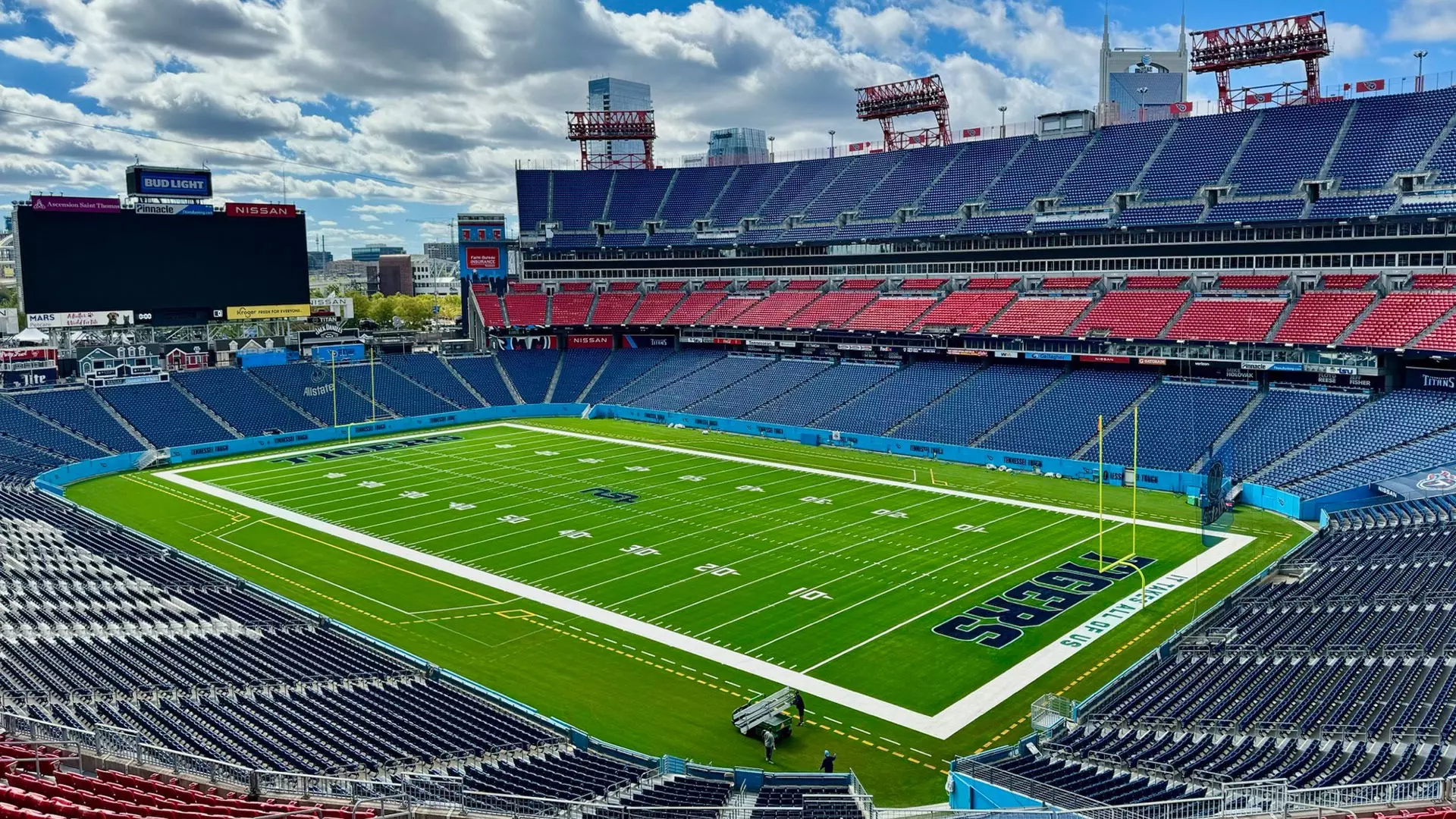
For 27 seasons, Tennessee State carried its history to Nashville’s East Bank. As the Tigers prepare to leave the original Nissan Stadium, they are saying goodbye to a building—not to downtown, the Titans or the future they will continue to share.
NASHVILLE, Tenn. (TSU News Service) – The old stadium and the new one stand beside each other now, two generations of Nashville separated by little more than a construction fence.
One carries 27 seasons of Tennessee State football. The other is waiting for the Tigers.
On Nov. 14, 2026, Tennessee State will face Eastern Illinois at 2:32 p.m. in the university’s final game at the original Nissan Stadium. Fittingly, Eastern Illinois—the second opponent TSU faced in the building—will also be the last.
The afternoon will be larger than another opponent, kickoff or final score. It will be a farewell to the downtown stage TSU first entered in 1999 and a welcome to the new home rising a few yards away.
For those who remember the beginning, it is difficult to separate the stadium from the Nashville that surrounded it.
The skyline was smaller in 1999. The Shelby Street Bridge had closed to vehicles and had not yet reopened as the pedestrian walkway that would eventually carry thousands of fans across the Cumberland River. The Titans were new to Nashville. The Predators had played only one season. Much of the East Bank remained a collection of parking lots, industrial property and open space.
The stadium changed that view.
So did Nashville.
The bridge became one of the city’s most recognizable walkways. Towers appeared across the river. Lower Broadway became an international destination. New residents, hotels, businesses and entertainment venues reshaped downtown. The East Bank, once defined largely by the stadium and its parking lots, became the center of a redevelopment plan that will continue long after the original building is gone.
Through each version of Nashville, TSU remained part of the scene.
The building’s name changed with the city. It opened as Adelphia Coliseum, became The Coliseum after Adelphia’s name was removed, changed to LP Field in 2006 and took the Nissan Stadium name in 2015.
Four names. One footprint. Generations of Tigers.
For TSU supporters, the directions were often simpler than the official branding: The Tigers were playing downtown.
The relationship began before the first game.
As the NFL franchise prepared to complete its move to Nashville, TSU opened its campus as a training-camp home in 1998. Then TSU President James Hefner developed a relationship with franchise founder K.S. “Bud” Adams Jr., a university benefactor who understood that professional football’s arrival could create opportunities beyond the Titans.
The resulting agreement brought together TSU, the Titans, the Tennessee Board of Regents, and the Metro Sports Authority. It allowed TSU to play home games in the new stadium and provided the Tigers with their own locker room and meeting space.
TSU was not simply using an NFL field for an occasional classic. The university was part of the building’s identity.
Jim Smith was TSU’s athletics director when the stadium opened. Teresa Phillips guided the department through most of the building’s life. Mikki Allen oversaw improvements and helped guide the department into the new-stadium era. Jennifer Bell, a university administrator for more than three decades, is leading the department through the final season as interim athletics director.
Former President Glenda Glover helped preserve TSU’s visibility inside the original stadium and its place in the one being built next door. Across changing university administrations and Titans leadership groups, the relationship endured because the people involved treated it as more than a lease.
TSU played its first game there on Sept. 3, 1999.
L.C. Cole’s Tigers defeated Alabama State 41-8 in the inaugural John A. Merritt Classic before 31,119 fans. TSU entered its new home with the confidence of a program that understood its history.
That team completed an 11-0 regular season. A crowd of 41,132 watched TSU defeat Tennessee Tech 25-19, the largest recorded attendance for a TSU game in the building. The Tigers climbed through the national rankings and turned the new stadium into a championship home during its first autumn.
The defining moment arrived Nov. 13 against Murray State.
Avion Black returned the opening kickoff 83 yards for a touchdown. Brent Sterling returned an interception 50 yards for another score. Quarterback Chris Perkins threw three touchdown passes, and TSU carried a 33-14 lead into halftime.
Murray State answered with 27 consecutive points and took a 41-33 lead in the fourth quarter. The undefeated season and conference championship suddenly felt uncertain.
Black caught a 30-yard touchdown pass from Perkins with 4:14 remaining. TSU regained possession with 2:06 left and moved into field-goal range. With three seconds showing, both teams used timeouts.
The stadium waited.
Seth Goodowens kicked a 37-yard field goal as the clock reached zero.
Tennessee State 42, Murray State 41.
It was a Music City miracle of TSU’s own, nearly two months before the Titans produced the play that would give the phrase national meaning in an AFC wild-card game.
The Tigers had won their second consecutive Ohio Valley Conference championship. Two days later, they became the No. 1 team in Division I-AA.
That finish gave the stadium its first unforgettable TSU moment and began a story that would take 25 years to complete.
James Reese and James Webster carried the program through the building’s early years and its first changes in name. Rod Reed, a former Tennessee State player, spent 11 seasons leading his alma mater. His tenure included a 10-win season in 2013 and TSU’s first FCS playoff victory since 1986.
Eddie George’s arrival in 2021 joined the histories of TSU and the Titans in one figure.
George had helped establish professional football in Nashville. His image appeared on the stadium walls. He had carried the ball there as one of the Titans’ defining players, then returned years later wearing TSU blue as a first-time college head coach.
In 2024, George led the Tigers onto that familiar field against No. 11 Southeast Missouri State with a championship at stake.
Draylen Ellis passed for 232 yards and two touchdowns and rushed for another score. CJ Evans caught six passes for 107 yards and a touchdown. TSU held SEMO to 75 rushing yards and won 28-21.
The victory secured a share of the Big South-OVC championship. It was Tennessee State’s first conference title in 25 years, George’s first as a head coach and the first won while the building carried the Nissan Stadium name.
Cole’s team had secured a championship on that field in 1999. A quarter-century later, George’s Tigers provided the other bookend.
Between those titles came players and performances that became part of the building.
Dominique Rodgers-Cromartie developed into one of the greatest defensive backs in TSU history while playing his home games downtown. A three-time first-team All-OVC selection and FCS All-American, he became the 16th overall selection in the 2008 NFL Draft and played 12 professional seasons.
In the 2008 John A. Merritt Classic, TSU trailed Southern by 11 points at halftime before rallying for a 34-32 victory in front of 28,830 fans. Antonio Heffner passed for 315 yards and three touchdowns. Chris Johnson caught seven passes for 158 yards and two scores, including an 81-yard touchdown that changed the game.
The crowds kept bringing new memories. More than 31,000 watched TSU defeat Arkansas-Pine Bluff 40-13 in 2012. Six years later, the 20th John A. Merritt Classic produced a 34-3 victory over Bethune-Cookman and 525 yards of Tennessee State offense.
In 2023, Terrell Allen delivered one of the greatest defensive performances in program history against Lindenwood. He finished with a school-record 6.5 tackles for loss, 4.5 sacks and two forced fumbles. Allen ended the season as the FCS leader in sacks and tackles for loss and became TSU’s first winner of the Buck Buchanan Award.
The stadium’s final season produced one more ranked Homecoming victory.
TSU defeated No. 24 Morgan State 25-16 on Oct. 17, 2026. Freshman Rymen Mosley intercepted two passes in the first quarter. Daylin Lee passed for 220 yards and two touchdowns, and Cam Bulluck caught six passes for 105 yards and a score.
It was TSU’s eighth consecutive Homecoming victory and the 100th win of Barlow’s head-coaching career. Barlow will be the last Tennessee State coach to lead a team through the old stadium tunnel.
The box scores provide the easiest history to preserve. The rest belongs to the people who arrived before the gates opened and remained after the crowd had gone home.
For Tennessee State, behind-the-scenes staff members such as Uncle Gray, McKinley, Tess, Anthony, “Ballpark,” Lee, Nick, Dusty, Troop, Jared, Michelle, Krystal, Trevor, Harvey, Damon, JT and many others carried out that work through the stadium’s final seasons. Across game operations, personnel, parking, traffic, equipment, athletic training, communications, facilities and event management, they handled the details required to transform an NFL venue into TSU’s home for a day.
They adjusted when plans changed, filled gaps beyond their job descriptions and found solutions with the time, staffing, space and resources available. Students, interns and support staff joined that effort, including members of the Tiger Team whose work at Nissan Stadium helped prepare them for successful careers in marketing and promotions. They completed assignments most fans never saw. When everything worked, their contributions were almost invisible. That was often the clearest sign that they had done their jobs well.
On the Titans and stadium side, Walter Overton, Bob Flynn, Ashlee Stokely, Austin Mitchell, Gaby Barfield, Larry Burcher, Terry Porch, Brian Myers and many others shared in that responsibility. Across stadium operations, event management, facilities, security, parking and guest services, they worked alongside TSU to manage the countless details surrounding each game.
They were more than names on an event sheet. They were problem-solvers and partners who made demanding days feel collaborative and helped TSU preserve its identity inside a building shared with an NFL franchise, concerts, international soccer matches and some of Nashville’s largest events.
The relationship also was sustained by Titans leaders such as Bud Adams, Amy Adams Strunk, Jeff Diamond, Steve Underwood, Adolpho Birch III, Burke Nihill, Tina Tuggle and Johari Matthews, along with many others who understood that TSU’s presence was not simply part of a stadium agreement. It belonged in the history of the building.
The people who described the games became part of the story, too.
Inside the stadium, public-address voices Ernie Allen, Phyllis Qualls-Brooks and Chip Hoback gave game day its rhythm. They introduced the Tigers, celebrated their accomplishments and carried their names throughout the seating bowl.
Greg Pogue became the Voice of TSU Football, bringing game days to listeners throughout Nashville. Barry Gresham, Albert Dawson and Howard Gentry Jr. also helped generations of Tiger fans follow the action when they could not be in the stands. The radio home changed through the years, but the connection endured as TSU games moved across Nashville’s airwaves on WNSR 560 AM, 102.5 The Game, 94.9 The Fan and 102.1 The Ville. Online streaming and SiriusXM later carried those broadcasts beyond Middle Tennessee, allowing alumni and supporters across the country to remain connected to the Tigers.
Television coverage expanded with the technology. Games that reached viewers through Comcast Sports Southeast, Fox Sports South and ESPN3 eventually moved to ESPN+, giving TSU’s home schedule a consistent national platform. In the stadium’s final years, Dan Laing, Chris Sanders, Darren Arbet and Dean Cokinos brought the action to those audiences and provided another window into Tennessee State football.
Newspaper, independent and HBCU media extended TSU’s story beyond the stadium. Anthony Coleman chronicled the Tigers for The Tennessean as the downtown era began, followed by Maurice Patton and longtime TSU beat writer Mike Organ. David Climer, whose Tennessean career began covering TSU, remained one of Nashville’s defining sports columnists. Ron Wynn covered the program for The Tennessee Tribune, while Cass Teague and Mike Patton chronicled TSU through Nashville’s independent media. Carl “Lut” Williams, Steven J. Gaither, Kenn Rashad, Kendrick Marshall and Chris Stevens carried the Tigers’ stories to HBCU audiences across the country. Associated Press veteran Teresa Walker and Washington Post writers Cindy Boren and Michael Lee also brought important TSU stories to national audiences.
Together, their work preserved the voices, moments and memories of TSU football long after the crowds had gone home.
No group made the building feel more like TSU than the Aristocrat of Bands.
The Grammy-winning band gave the East Bank its Big Blue soundtrack. The Sophisticated Ladies brought precision, movement and style. Cheer and dance carried the university’s energy from the sidelines to every corner of the building.
When the new Nissan Stadium broke ground on Feb. 29, 2024, the Aristocrat of Bands was there. The band provided the ceremonial drumroll and performed as guests arrived. George stood among those in attendance, a Titans legend and Tennessee State coach watching the next shared home begin to rise.
It was an appropriate image for the transition: TSU’s sound carrying from the old stadium toward the footprint of the new one.
The next Nissan Stadium is scheduled to open in 2027. It will be enclosed beneath a translucent roof and feature closer sightlines, exterior terraces and year-round community space.
It will host the Titans, Tennessee State football, concerts and annual events such as CMA Fest. In 2030, it will welcome Super Bowl LXIV. Its enclosed design also will allow Nashville to pursue the College Football Playoff National Championship, the NCAA Final Four, WrestleMania and other events beyond the original stadium’s reach when it opened.
The arrangement ensures that TSU will remain part of the East Bank’s future, carrying its downtown tradition into a new stadium that will give the Tigers, alumni and supporters a new place to gather for years to come.
Those commitments preserve more than dates on a schedule. They preserve Tennessee State’s place in Nashville’s future.
The new building will open in a part of the city almost unrecognizable from the East Bank of 1999. Streets, parks, residences, businesses and public spaces are planned around it. The original stadium will eventually disappear, and the land beneath it will take on a new purpose.
TSU, however, is not leaving downtown.
The Tigers are moving next door.
Saturday afternoon will bring one final walk through the old locker room, one final trip down the tunnel and one final game beneath the open sky.
It will recall Cole and the undefeated Tigers of 1999, Reed leading his alma mater, George returning to his Titans home in TSU blue and Barlow guiding the final team onto the field. It will bring back Homecoming crowds, John A. Merritt Classics, tailgates along the river, radio broadcasts, public-address calls and the AOB echoing through the stadium after the players had left the field.
The final game should be a moment of gratitude more than grief.
TSU can thank the stadium for providing a downtown stage and the people from TSU, the Titans and Metro Nashville who worked to make the relationship last. It can thank the coaches, players, band members, spirit groups, employees, journalists, alumni and fans who filled the building with something concrete could not provide on its own.
Then TSU can turn toward the structure rising next door.
The skyline will continue to change. The old stadium will come down. The Nissan Stadium name will move into a new building.
The history will move with it.
The original stadium gave Big Blue a stage.
The new one will inherit its sound.
About Tennessee State University
Founded in 1912, Tennessee State University is Nashville’s only public land-grant university offering 41 bachelor’s degrees, 15 graduate certificates, 27 master’s degrees, and nine doctoral degrees. TSU’s campus spans 500 acres. The university is committed to academic excellence, providing students with a quality education in a nurturing and innovative environment that prepares them as alumni to be global leaders. Visit tnstate.edu for more details.